

Just War Theory
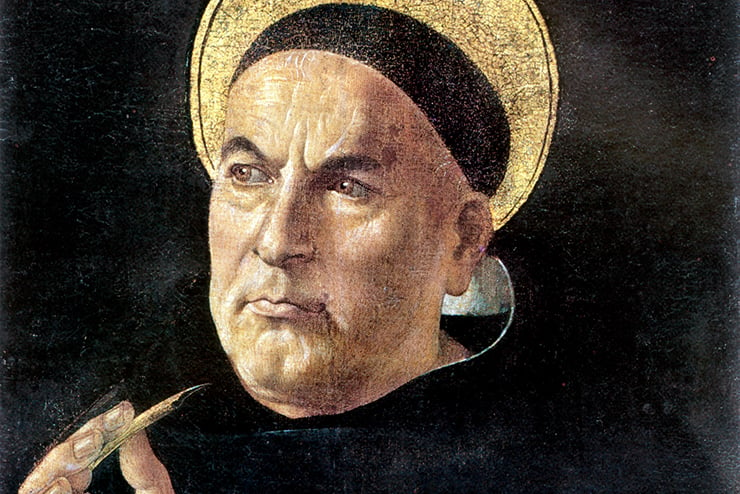
St Thomas Aquinas
Can it ever be right to go to war?
Although all war, as the veteran Harry Patch said, is legalised murder, it is the case that some wars are more murderous than others.
Between the extremes of the national extremist, who proclaim that any war that their nation wants to get into is right, and pacifists, who believe that all wars are wrong, lies the Just War theory.
The Theory
Just War theory goes back to the ancient Egyptian civilisation, but was more methodically developed by Aristotle, continued by Augustine, and is usually associated with Thomas Aquinas. The central theme is that the war should be defensive, not aggressive.
Modern views of when it is right to go to war hover around these principles:
- Competent Authority; It has to be a Government that declares war, not a self constituted group. The practicality of this principle is hard to see. A war is a war, irrespective of who declares it.
- Probability of Success; this is more reasonable, though emotion, not reason, is the prime motive at work in war. Hamas should have considered this principle before launching its October 7th attack in 2023
- Last Resort; This is certainly reasonable. It applies very much to the illegal attack launched on Iran by Trump and Netanyahu in 2026
- Just cause; summarised by the US Catholic Conference in 1993: “Force may be used only to correct a grave, public evil, i.e., aggression or massive violation of the basic human rights of whole populations.” This lies behind the UN’s Responsibility to Protect principle, although it has not been applied to the arguably genocidal onslaught of Netanyahu on Gaza still ongoing in 2026.
Politicians in 2026 seem to have set aside any considerations of Just War theory by the simple ploy of not calling what they are doing by the name of “War”. Putin calls his invasion of Ukraine a “Special Military Operation”. Trump is not mentioning the word “War” in the context of his assault on Iran and thinks he can get away with it.
This kind of semantic avoidance of rules must be offset by the United Nations making a judgment on whether an action is a war or not, and acting on that judgement. The problem here is that the UN has been effectively sidelined by the USA in the 21st century. so putting power ahead of principle, might instead of right.
In Practice: the 2022 Invasion of Ukraine
Although it is sometimes the case that both sides bear an equal weight of responsibility for a war, the 2022- war in Ukraine shows that sometimes, the immediate cause of war is unilateral, since Putin ordered an invasion on 24th February 2022.
There are antecedent causes of the war which go back to 2014 with the separatist troubles in the Donbas, and to the Maidan Revolution (which Putin and his supporters characterise as a “coup”). Putin also has a range of grievances associated with the expansion both of NATO and of the EU. His mistake was that he chose not to invoke Article 6 of the UN Charter which are designed to address precisely the concerns he has, but instead chose to invade.
Once Putin had invaded, Ukraine had no option but to resist. To stay a free nation, they had to fight. If the Government had fled, and the Ukrainian Army had surrendered, an occupation would have followed, probably with a smouldering guerrilla war fought against the occupiers that would build after a generation or so to an outright war to obtain freedom. The capitulation of Ukraine would undoubtedly have encouraged Putin to expand into other countries bordering Russia with a sizeable Russian speaking minority. So we may say that Ukraine is justified in its war, and Russia is unjustified.
All of which show that the pathogenesis of war can be both simple (in this case, invasion by a dictator) and complex (in this case, separatist sentiment in the Donbas, foreign intervention, and diverging views as to whether Ukraine should team up with the EU or with Russia).
Given that wars may be seen as “‘just” only with a certain amount of mental gymnastics, the main question is, how can the outbreak of collective or political insanity be prevented?
The second part of Just War theory relates to behaviour in war, and is rather more productive, as it provides the foundation of War Crime Law.
Principles of war
“Kill the poys and the luggage! ’tis expressly against the law of arms: ’tis as arrant a piece of knavery, mark you now, as can be offert’ – Fluellyn, Shakespeare, Henry V
The principles of the conduct of a war are:
- Distinction; combatants are the target and non-combatants are not to be targeted
- Proportionality; civilian damage must not be too great in comparison to the military objective
- Military necessity; pretty much the same as proportionality
- Fair treatment of prisoners of war
- Nothing to be used which is evil in itself; that is, mass rape, biological, chemical and nuclear weapons
All of these principles seem to be violated in Putin’s war on Ukraine and Netanyahu’s attacks on Palestinians. Nuclear war cannot be justified at all under these principles.
The third set of principles: settlement after a war
Justice after a war concerns:
- peace treaties
- reconstruction
- environmental remediation
- war crimes trials,
- war reparations.
Clearly these principles are vitally important in the prevention of follow-on wars, as the world found out to its cost by imposing too harsh reparations on Germany after the First World War, which threw Germany into a state which brought about the Second World War.
Conclusion
Although war can be seen as a form of political insanity, it is important that philosophers and jurists keep looking at war, and try to provide principles and laws that to some extent will limit the damage that wars do.

