

The essential choice for humanity:
arms escalation or de-escalation?

Image above thanks to ChatGPT – note that although it reproduced the basic form of a balance, it did not quite understand the mechanism. (Artificial but not all that Intelligent)
In 2026, many governments are increasing their defence spending, escalating their military capabilities, which means that we are in an arms race – and not just a race in conventional arms, but, sadly, there is evidence that in 2026 we are also in a nuclear arms race.
There are three main causes for an arms race – mutual paranoia, the billionaire-owned media, and the military industrial complex.
Arms races are often a factor in the lead-up to war, the main example being the first World War, which was preceded by a battleship-building contest between Britain and Germany. Whether or not arms races always lead to war is a matter of debate, but what is certain is that an arms race will increase the level of mutual paranoia.
Mutual Paranoia
The psychological basis of military escalation is mutual paranoia1, that is, the belief that another state or organisation is planning to attack one’s own state. The belief may or may not have a basis in reality, but in either case, the build-up of one side causes a build-up on the side of the perceived adversary, so that the belief brings the idea into reality. Escalation is a vicious circle, resulting in an arms race.
The good news is that things are not as bad as our minds tend to assume. Psychologists have studied peoples’ beliefs about how much other people lie and cheat, and found that people underestimated the honesty of other people by a significant amount. When they were informed about the real level of honesty, their estimations became more accurate. This information will translate well to international relationships, because negotiators are human beings when all is said and done.
The “news” agents
The mainstream press knows that wars sell newspapers, so this tends to make them assume a hawkish tendency, allied to the fact that their owners exists in the super rich strata of society that includes the Military Industrial Complex.
Let’s hear it from the man himself:
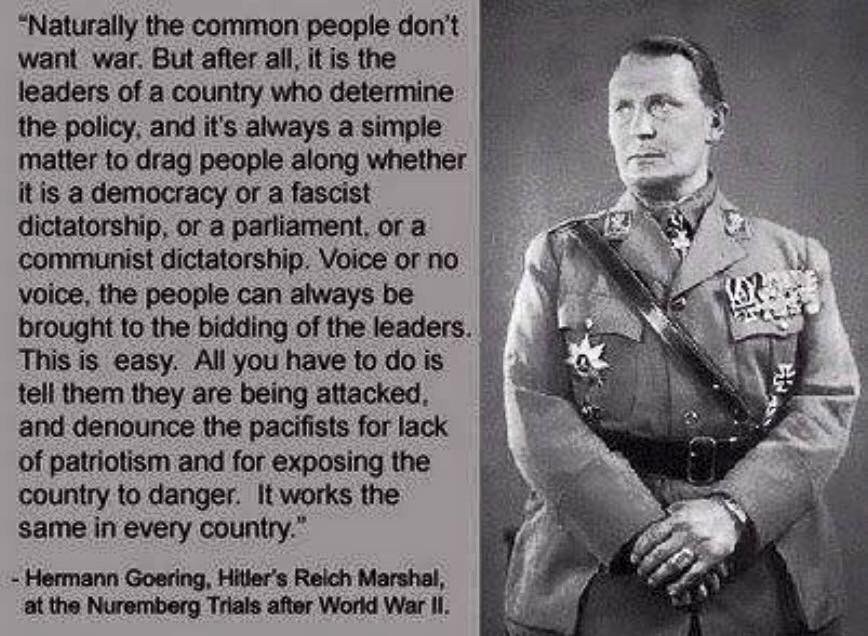
Billionaires own most newspapers in the UK, and their ideological views inevitably influence the editorial policy of the papers (and broadcasting stations) they own.
The Military Industrial Complex
The Military Industrial Complex (MIC) – a term which describes the relationship between a nation’s military, the arms manufacturers who supply it, and the politicians (often the recipients of donations from said manufacturers) who decide on the amount of taxpayers money that will be made available to them – is an important economic driver of militarism, which supplements and exploits the psychological state of mutual paranoia.
It involves immense amounts of money – $2.8 Trillion per year in 2024, up from $1.7 trillion in 2011 (source).
| Nuclear Expenses In 2025 the nuclear-armed nations spent $3,768 per second on their nuclear arsenals. That adds up to $119 billion. Source: International Campaign Against Nuclear Weapons, ICAN . It is a 19% increase from 2024 spending ($16.8 billion). |
Militarism has a massive ecological footprint. A recent report by Scientists for Global Responsibility concluded that the military are responsible for about 5% of global CO2 emissions, and that the military would rank as fourth in the nations of the world as a CO2 source. It is therefore absolutely necessary to produce a more peaceful world not just from a humanitarian standpoint but also from the ecological point of view.
The MIC therefore has immense political influence. The sole reason for arms manufacturers to exist is to increase their profits, and they are the only organisations who stand to profit from war (aside perhaps from the construction industry). Everyone else loses.
Comparing escalation and de-escalation
The rationale of escalation is to achieve parity between the parties, but this parity is an elusive fantasy, because secrecy is the order of the day on both sides, and this makes verification impossible. Also, mutual paranoia magnifies the power of the perceived adversary.
In short, escalation, driven by the Military Industrial Complex, is:
- expensive
- dangerous
- unable to achieve balance or parity
- not verifiable
- stops us from stabilising climate, nature and society
- based on mutual paranoia
In contrast, de-escalation, a mutual winding-down of military spending, is:
- inexpensive
- leads to safety
- able to achieve balance of power
- verifiable
- enables us to stabilise climate, nature and society
- based on trust building
So by every measurement, de-escalation is the better and more reasonable option.
There are just two blocks in the way of de-escalation:
First, the lobbying power of the military-industrial complex, and
Second, the propensity of the human mind (and media) to fall for paranoia instead of working to build trust. Psychologists discovered in 2025 that humans have a marked bias towards distrusting others.
Neo-liberalism
The ideology of neo-liberalism underpins the power of the MIC, putting it alongside the fossil fuel industry in terms of its influence on politicians.
Neoliberalism can be defined as the doctrine that
-self-interested men,
-competing against each other for money,
the love of which is deemed in the Bible to be the root of all evil,
-without any external restraint or control,
-will produce the best of all possible worlds.
Despite being clearly questionable (not to say absurd), neoliberalism is the dominant economic theory of our times.
The work of the global peace movement is to persuade politicians to move from escalation to de-escalation, and the main task here is to help them develop the skills of trust building.
The mega-corporations, the multinationals or transnationals are the real rulers of our time. Just as the fossil fuel companies are using their immense profits to resist the transition to safe energy that is not going to cause Earth to overheat, so also the Military Industrial Complex will oppose any and all attempts to create a more peaceful world. This page explores how we can bring multinational corporations back under democratic control.
Next: Conventional war can escalate into global nuclear war
- See also War as Political Insanity ↩︎

